Sauna running costs
How Much Does an Electric Sauna Cost to Run in Canada?
Estimate electric sauna running costs using kWh, session time and your own tariff. Includes clearly labelled CAD examples and monthly calculations.

Before you begin
- Estimate costs from energy used in kilowatt-hours, rather than the heater’s power rating alone.
- Account for preheating and session time without assuming the heater draws full power throughout.
- Apply your own tariff and usage-dependent charges, then refine the estimate with actual usage data.
You do not need a national average to make a useful sauna running-cost estimate. You need your heater’s actual output, the energy used during a session and the applicable charges on your electricity bill.
The examples below use Canadian dollars and deliberately invented electricity rates. They explain the calculation; they are not current tariffs, measured heater results or a promise about your bill.
Start with kilowatts and kilowatt-hours
Kilowatts, or kW, describe power. Kilowatt-hours, or kWh, describe the energy used over time. A heater drawing 8 kW continuously for one hour uses 8 kWh. Multiply the energy by a price per kWh to estimate the electricity charge. US Department of Energy: energy-use calculation
Energy in kWh × applicable dollars per kWh = estimated charge
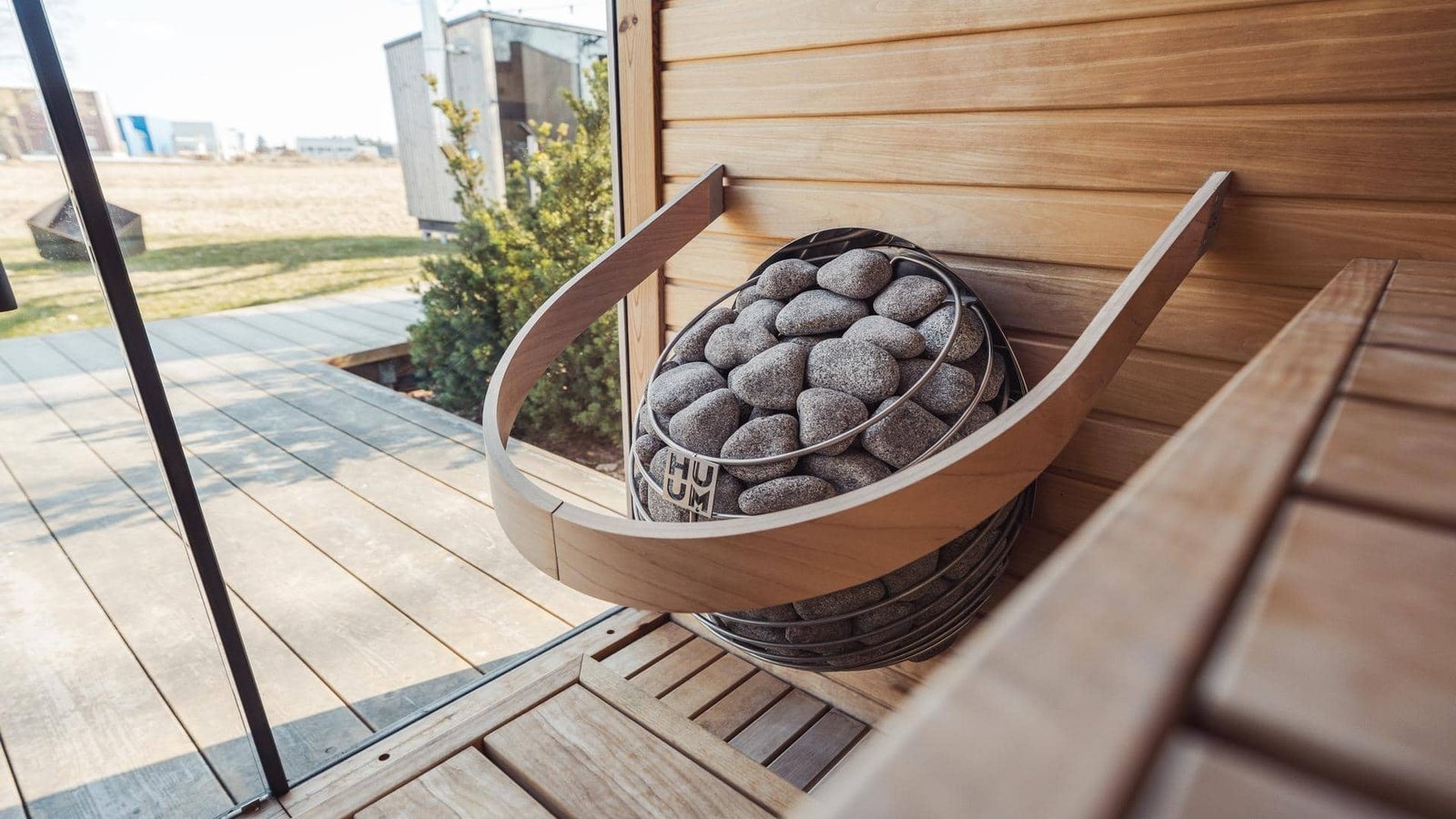
While comparing the sauna heater range, make sure the output you record belongs to the exact electrical variant. Then separate the time the system is switched on from the time its heating elements actually draw full power.
A simple full-power example
Suppose an 8 kW heater draws full power for 45 minutes. Forty-five minutes is 0.75 hours, so the energy is:
8 × 0.75 = 6 kWh
At an illustrative rate of CAD 0.15 per kWh, the electricity charge would be CAD 0.90. At CAD 0.25 per kWh, the same 6 kWh would cost CAD 1.50.
Neither example estimates a complete session unless the complete session actually consumes 6 kWh. Preheating, time spent bathing and any powered drying period need to be accounted for. Accessories or a climate device may also use electricity beyond the heater elements.
Add the bathing period without assuming constant full power
For a more detailed hypothetical example, assume:
- An 8 kW heater runs at full power for 45 minutes before use.
- During a further 45 minutes, its average power is equivalent to 50% of full output.
- The illustrative electricity price is CAD 0.20 per kWh throughout.
Preheating uses 6 kWh. The later period uses 8 × 0.75 × 0.5 = 3 kWh. Total heater-element energy is 9 kWh, giving an electricity charge of CAD 1.80.
At 12 identical sessions a month, the calculation gives 108 kWh and CAD 21.60. The 50% assumption is invented for the arithmetic; it is not an expected duty cycle for any product.
For comparison, continuous full output over those same 90 minutes would be 12 kWh and CAD 2.40 at the same illustrative price. This is a useful heater-element estimate for that defined duration, not a universal upper limit on a household’s sauna bill.
Use the right part of your electricity bill
The advertised energy price may not represent every variable charge. Hydro One, for example, separates electricity, delivery and other bill components, and its time-of-use pricing varies with the applicable period. Your provider and plan may work differently. Hydro One bill explanation
For a quick comparison, label your result “electricity commodity charge” if that is the only rate you use. For an estimate of the increase in your bill, include applicable usage-dependent charges, adjustments and taxes. Avoid assigning an existing fixed monthly charge to every sauna session as though the sauna created that charge.
If a session crosses pricing periods, split its energy accordingly. An average rate is convenient, but the calculation should say that an average was used.
Improve the estimate with your own observations
Once the sauna is operating, keep a short record of the starting conditions, preheat duration and total session time. Your utility’s interval data can help compare usage, although whole-home readings also include other appliances. Hydro One provides hourly, daily and monthly usage views in its account tools. Hydro One usage information
Avoid confusing a cold-weather cabin session with an indoor session that begins in a warm building. Repeat the comparison under similar conditions before drawing conclusions about a new operating habit.
Choose a heater that suits the room instead of buying less output solely to reduce the number on the label. Review the model’s room requirements in the sauna heater manuals. Better budgeting starts with a suitable system and clear assumptions about its use.
Sauna running-cost questions
Is a 6 kW heater always cheaper per session than a 9 kW heater?
No. Per-session cost depends on total energy use, not just rated power. Comparing two different rooms or warm-up durations can reverse a simple comparison based on the labels.
Does a 90-minute session mean 90 minutes at full power?
Not necessarily. Control behaviour and room conditions affect the draw over time. Use measured energy where available, or state any assumption about average power explicitly.
Can Wi-Fi controls reduce electricity costs?
They may help you avoid starting earlier than needed, depending on your habits. Connectivity alone does not establish an energy saving. Compare your actual usage before and after a change.
What number should I budget each month?
Estimate energy per session, multiply by expected sessions, then apply your own tariff and relevant variable charges. Revisit the estimate after you have real usage data.
Sources
- US Department of Energy, Energy Efficiency and Renewable Energy. Watt Does It Cost to Use It?. Undated educational resource; used only for the stable kWh calculation method. Accessed 9 September 2026.
- Hydro One. Understand My Bill: Time-of-Use. No publication date shown. Used for billing structure and usage-data guidance, not the illustrative rates above. Accessed 9 September 2026.